This guide is for adults in the UK who have tested positive for H. pylori and have been given treatment, or are about to start it. It explains what H. pylori treatment involves, how to get through the course, and how you find out if it has worked. It also covers what usually happens if the infection does not clear or comes back. However, it cannot replace advice from the person who prescribed your medicines, so always follow their instructions first.
Key points
- Treatment usually means an acid-reducing medicine plus two antibiotics, taken together for about a week, sometimes longer.
- Taking every dose, exactly as prescribed, gives the treatment the best chance of working.
- Side effects such as a strange taste, feeling sick or loose poo are common but usually mild.
- Feeling better does not prove the infection has gone. Only a test can show that, so ask whether you need one.
- If the first course does not work, a second course with different antibiotics is usual. After that, your GP should get advice from a specialist who works in gastroenterology.
What H. pylori treatment involves
H. pylori (Helicobacter pylori) is a germ that can live in the lining of your stomach. If you have not had a test yet, our guide to H. pylori tests explains how it is tested for. Once a test is positive, your GP or specialist will usually offer treatment to clear it.[1]
In the UK, the usual first treatment combines three medicines. You take a proton pump inhibitor (PPI), such as omeprazole or lansoprazole, to lower stomach acid. In addition, you take two antibiotics, usually amoxicillin plus either clarithromycin or metronidazole.[1] If you are allergic to penicillin, your prescriber will choose a different pair instead.[1]
NICE recommends taking the course twice a day for 7 days.[1] However, some specialists now suggest 14 days, and Guts UK says a two-week course is now seen as more effective.[3][7] Some regimens also include a medicine containing bismuth.[2][3] So your course may look a little different from a friend’s, and that is normal. Your prescriber also takes into account any antibiotics you have had before, as well as local and national guidelines.[1]
Why finishing the course matters
H. pylori is hard to clear, which is why you need more than one antibiotic at once. Guts UK says treatment is much more successful when you take the whole course exactly as prescribed.[3] Similarly, UK guidance asks clinicians to stress how important it is to take every dose.[2]
Missed doses also matter beyond this course. Each extra course of some antibiotics raises the chance that the germ becomes resistant to them.[2] As a result, a course that fails can leave you with fewer good options next time. In other words, one week of careful effort now can save you a longer, harder course later.
Getting through the H. pylori treatment course
A week of tablets twice a day sounds simple. In practice, though, juggling several packets is easy to get wrong. These are small steps I recommend to patients in clinic to help get it right first time.
- Read each label before you start, because the medicines may have different instructions about food.
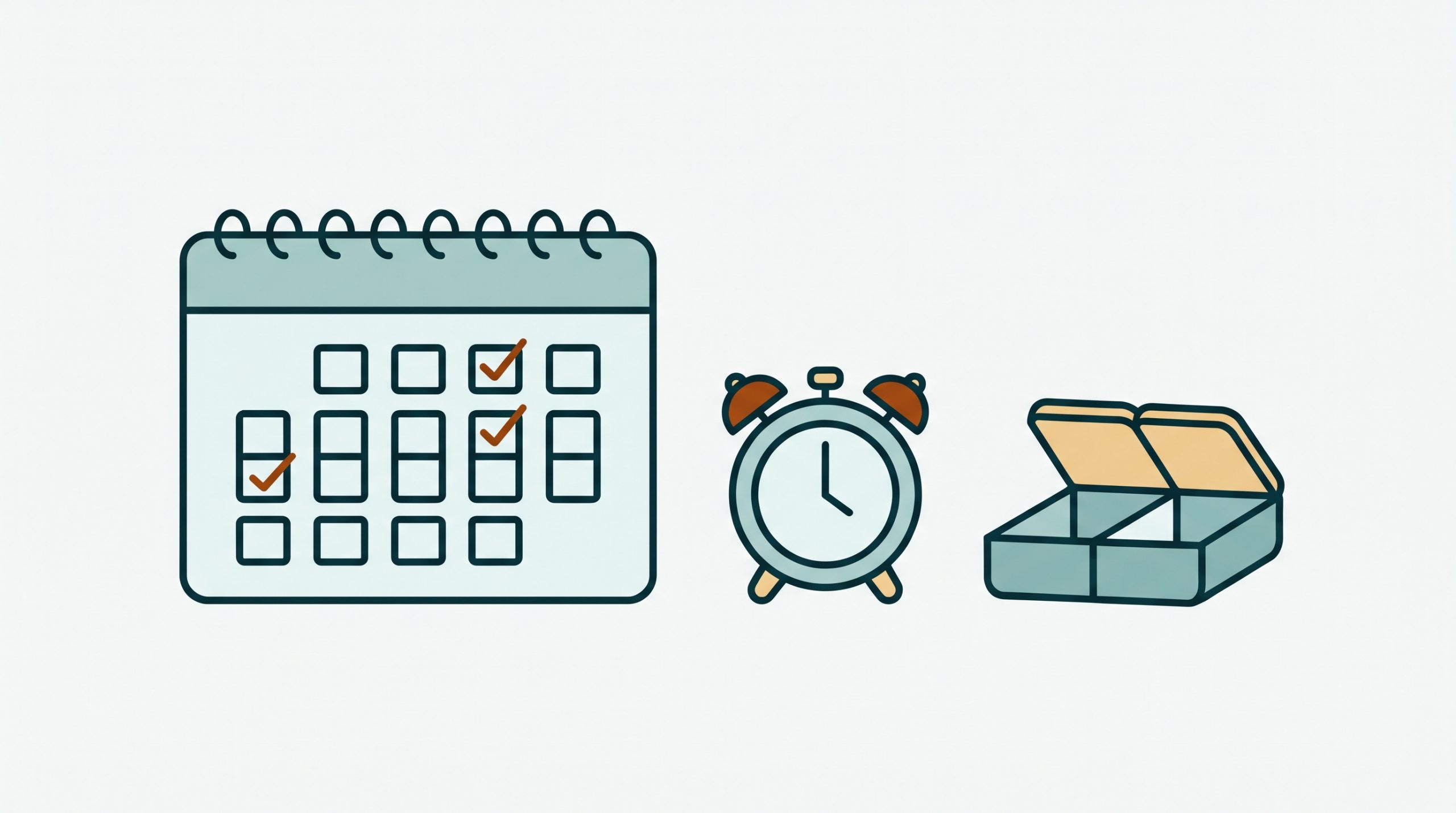
- Set two phone alarms, for example with breakfast and with your evening meal.
- Tick off each dose on a calendar or in our free symptom diary, so you can see at a glance if you missed one.
- Pick a start date when you are not travelling or at a big event.
- Tell your pharmacist about any other medicines or supplements you take, since some can interact with antibiotics.
- If you miss a dose, check the leaflet or ask your pharmacist what to do, rather than guessing.
If you are on metronidazole, avoid alcohol completely. The NHS says not to drink while you take it, and to wait 2 days after you finish. Otherwise, you may feel sick, get a headache, hot flushes or a racing heart.[4] Guts UK gives the same warning for this antibiotic.[3]
Coping with side effects
Many people have no side effects at all. When they do happen, they are usually minor, such as a strange taste, feeling sick, loose poo (diarrhoea) or a headache.[3] For example, metronidazole can cause a metallic taste or a furry tongue. The NHS suggests taking it after a meal or snack if it makes you feel sick.[5]
Mild side effects usually settle once the course ends. So if you can, keep going and speak to your pharmacist for tips. Do not stop early without advice, because a half-finished course is less likely to work.[3] On the other hand, contact your GP, pharmacist or NHS 111 if side effects are severe, or if you think you are having an allergic reaction.
How you find out if it has worked
Feeling better is a good sign, but it does not prove the infection has gone. In fact, a BSG education article notes that symptoms alone are not a reliable guide to whether treatment worked.[7] Many people also have ongoing tummy symptoms for other reasons after H. pylori clears.[2]
Whether you get a check-up test depends on why you were treated. NICE does not advise a repeat test for everyone.[1] Even so, Guts UK and the BSG article favour confirming that the germ has gone.[3][7] For this reason, it is worth asking your GP or specialist whether they plan to retest you.
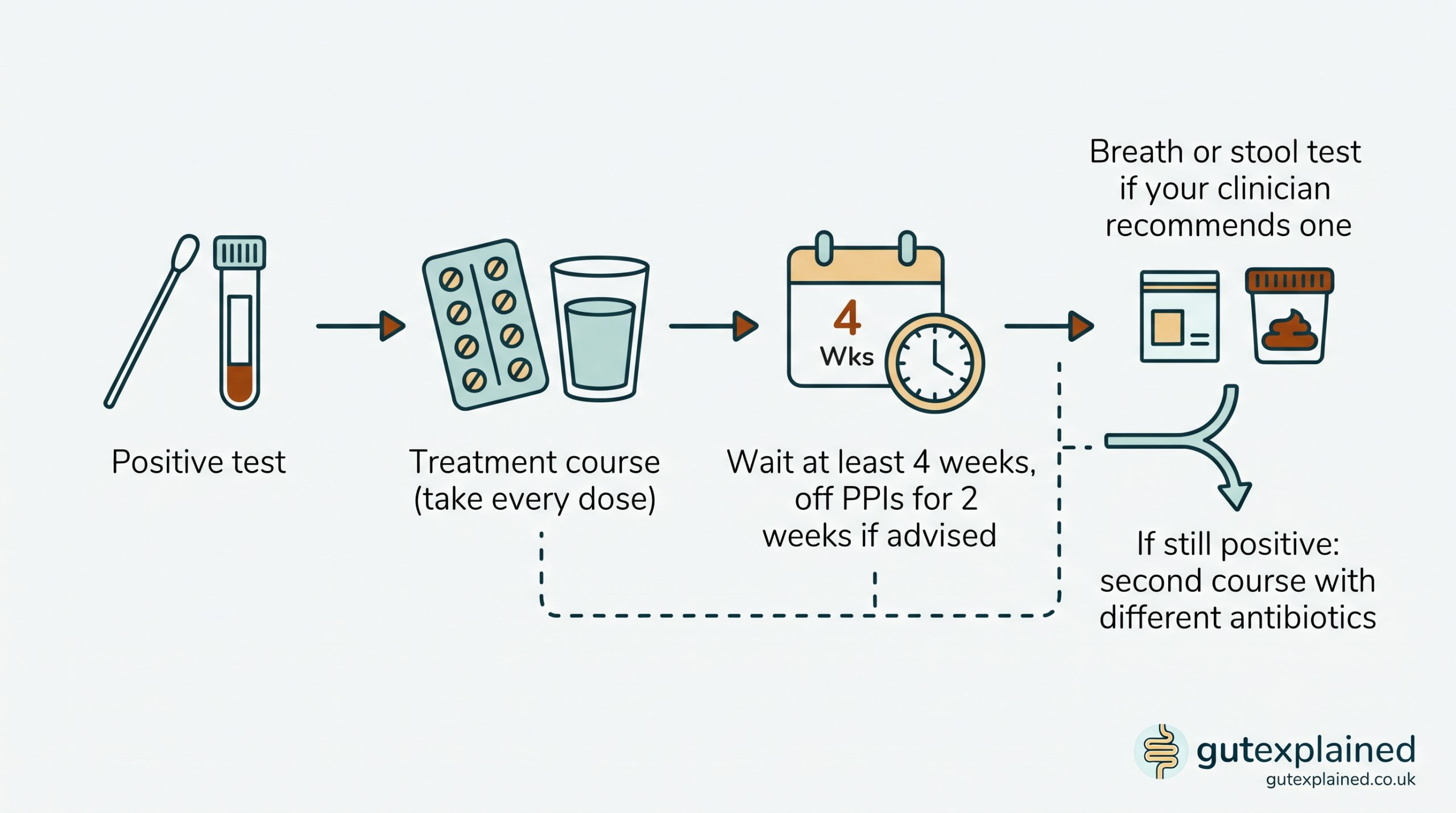
If you do have a test, timing matters. NICE recommends a breath test for retesting.[1] UK guidance says to wait at least 4 weeks after finishing treatment, and ideally 8 weeks.[2] You also usually need to stop PPIs for 2 weeks before the test, because they can give a false result.[1][2] However, only stop a PPI if your GP or clinic tells you to. They can then suggest what to take for symptoms in the meantime.
If H. pylori treatment does not work
Treatment does not always clear H. pylori first time, and that is not your fault.[3] If your test is still positive, the usual next step is a second course with a different combination of antibiotics.[1][2] Your prescriber will avoid the antibiotics you had before where possible.
Some second-line options include levofloxacin, an antibiotic from the fluoroquinolone family. Since January 2024, the MHRA (the UK medicines regulator) says doctors should only use these when other usual antibiotics are not suitable.[6] This is because they can rarely cause serious side effects involving tendons, muscles, joints, nerves or mental health. If you are given one, stop taking it and contact your doctor straight away if you notice signs such as tendon pain, tingling or changes in mood.[6]
If a second course also fails, NICE advises your GP to seek advice from a gastroenterologist.[1] In that case, the specialist may suggest a longer course or a test on a sample from a gastroscopy to see which antibiotics will work.[2][7]
Can H. pylori come back?
Once H. pylori has truly gone, catching it again as an adult is very unusual, according to Guts UK.[3] So when people say it has “come back”, it often means the first treatment did not fully clear it. That is one more reason a check-up test can be useful.
Your symptoms may also return for other reasons. For example, gastritis, reflux or a sensitive stomach can all cause similar discomfort. Our guides to gastritis and acid reflux explain these. Rather than guessing, speak to your GP if symptoms come back or do not settle. The NHS says you may need a different medicine, or treatment for longer.[8]
When to get help
Warning signs to act on
Call 999 or go to A&E if you vomit blood or have sudden, severe tummy pain. Also call if you have black, tar-like poo and feel faint or very unwell, or if you have signs of a serious allergic reaction, such as a swollen face or trouble breathing.
Contact your GP urgently or call NHS 111 if you have severe or bloody diarrhoea, if you cannot keep your tablets down, or if you notice blood in your poo.
Getting the most from H. pylori treatment and tests
Ben’s view: getting it right first time
As an independent prescriber, I talk about H. pylori treatment a lot. The conversation I have most is not about which antibiotics to use. Instead, it is about how to actually take them, twice a day, for a whole week or more.
My advice is to treat the course like a short project. Set your alarms, plan around the evening meal, and put alcohol on hold if metronidazole is in the mix. If side effects are a struggle, call your pharmacist before you stop anything. Often there is a simple fix.
Above all, do not judge success by how your stomach feels a few days later. Ask whether you need a test to check it has gone, and when to have it. That way, you know where you stand.
When H. pylori will not clear
The other piece of advice I would give is around H. pylori cultures. I often perform a gastroscopy for people whose infection has not cleared after previous treatment. During the test, I take biopsies that are sent for culture and sensitivity testing. This shows which antibiotic will work best, so the next course has the best chance of clearing it.
Preparation matters here too. Where I work, you need to stop antibiotics for 4 weeks and PPIs for 2 weeks before this test. Sadly, we sometimes have to cancel a procedure because someone has had antibiotics within 4 weeks, or is still taking a PPI. So if you are booked for H. pylori culture tests, contact your local endoscopy unit beforehand. They can confirm their own rules, which helps make sure your test goes ahead.
This kind of gastroscopy usually involves taking several biopsies. You will not feel them being taken. However, the test takes longer, often around 10 to 15 minutes, and the gas used during it can leave you feeling more bloated and uncomfortable. For this reason, I usually suggest sedation if you are able to have it, especially if you feel anxious or worry about coping with a longer test. If sedation is not suitable for you, that is fine too.
 Ben Johnson
Lead Author & Advanced Clinical Practitioner, Gastroenterology
Frequently asked questions
How long does H. pylori treatment take?
Most courses last 7 days, although some last 10 or 14 days.[1][2][3] Your prescriber will tell you how long yours is. Then, if you have a check-up test, it usually happens at least 4 weeks after you finish.[2]
Can I drink alcohol during H. pylori treatment?
Not if your course includes metronidazole. The NHS says to avoid alcohol while you take it and for 2 days afterwards.[4] For other medicines, check the leaflet or ask your pharmacist.
What if I miss a dose?
Check the leaflet for each medicine, or ask your pharmacist, because the advice can differ between them. Then carry on with the rest of the course. Missing doses can make treatment less likely to work, so tell your GP if you missed several.[3]
Why do I need to stop omeprazole before my retest?
PPIs such as omeprazole can hide the germ and give a false negative result. For this reason, UK guidance says not to do a breath or stool test within 2 weeks of taking a PPI.[1][2] However, only stop it if your GP or clinic advises you to.
Will clearing H. pylori stop my symptoms?
It often helps, especially if you had an ulcer, because treatment helps ulcers heal for good.[3] Even so, some people keep having symptoms for other reasons.[2] If that happens, speak to your GP about what to do next.
References
- National Institute for Health and Care Excellence. Gastro-oesophageal reflux disease and dyspepsia in adults: investigation and management (CG184), Recommendations. 2014, last updated October 2019 (minor update September 2024). https://www.nice.org.uk/guidance/cg184/chapter/Recommendations
- UK Health Security Agency. Helicobacter pylori in dyspepsia: test and treat (quick reference guide for primary care, v18.0, updated August 2019; page last updated 22 May 2025). https://www.gov.uk/government/publications/helicobacter-pylori-diagnosis-and-treatment
- Guts UK. Helicobacter pylori (H. pylori). Published November 2025, review due November 2027. https://gutscharity.org.uk/advice-and-information/conditions/helicobacter-pylori/
- NHS. Common questions about metronidazole. Page last reviewed 31 December 2025. https://www.nhs.uk/medicines/metronidazole/common-questions-about-metronidazole/
- NHS. Side effects of metronidazole. Page last reviewed 31 December 2025. https://www.nhs.uk/medicines/metronidazole/side-effects-of-metronidazole/
- Medicines and Healthcare products Regulatory Agency. Fluoroquinolone antibiotics: must now only be prescribed when other commonly recommended antibiotics are inappropriate. Drug Safety Update, 22 January 2024. https://www.gov.uk/drug-safety-update/fluoroquinolone-antibiotics-must-now-only-be-prescribed-when-other-commonly-recommended-antibiotics-are-inappropriate
- Bornschein J. Test and treat Helicobacter pylori (HP) in dyspepsia. British Society of Gastroenterology, education article. 20 February 2024. https://www.bsg.org.uk/Web-Education/Test-and-treat-HP-in-dyspepsia
- NHS. Stomach ulcer: treatment. Page last reviewed 12 August 2025. https://www.nhs.uk/conditions/stomach-ulcer/treatment/