
This guide is for adults in the UK who have had a gastroscopy, or are about to, and want to understand the words used on the report. It explains common terms in plain English, how biopsy results reach you and what usually happens next. It cannot tell you what your own report means for you. Only the team who did your test, or the doctor who referred you, can do that.
Key points
- A gastroscopy report is written for other clinicians, so it uses shorthand. Many of the words describe common findings.
- Someone may explain what they saw before you leave hospital, but biopsy results take longer: up to 2 months, or usually within 2 weeks if cancer is suspected.
- “Biopsies taken” is routine. It does not mean something serious was found.
- Some findings, such as Barrett’s oesophagus or intestinal metaplasia, can lead to repeat gastroscopies to keep an eye on things for you in the future.
- If anything on your report worries you, ask the team who did the test or your GP. Please don’t try to work it out alone.
Getting your results
A gastroscopy is a test where a thin, flexible tube with a small camera is used to look inside your gullet (oesophagus), stomach and the first part of your small bowel (duodenum). If you are not sure what the test involves, our gastroscopy guide and transnasal endoscopy guide explain the day itself. As a reminder, the term “endoscopy” simply refers to a type of camera test into the body, it does not tell you specifically what type of endoscopy it is. In clinic, I find this is something that people often confuse themselves with.
A doctor or nurse may explain what they saw before you leave hospital.[1] If you had sedation, you may not remember that conversation clearly, which is one reason many units give you a written report or a copy to take home. If you have had sedation, I also recommend that whoever is collecting you also sits with you for the results. You may not remember everything that is said.
If small samples of tissue were taken (biopsies), these go to a laboratory and you will need to wait for the results. The NHS says this can take up to 2 months. If doctors think you may have cancer, you will usually get the results within 2 weeks.[1] You may be offered a follow-up appointment to talk through your results and any treatment.[1] Taking biopsies does not hurt: you will not feel anything when they are taken, and you do not need to worry about having them taken.[2]
How your report is laid out
Reports vary between hospitals, but most include the same main parts:
- Indication. The reason the test was done, often copied from your referral.
- Sedation or throat spray. Whether you had medicine to help you relax, local anaesthetic spray to numb your throat, or both.
- Extent. How far the camera went. You may see “D2”, which is shorthand for the second part of the duodenum, the usual end point of the test for a standard diagnostic gastroscopy.
- Findings. What was seen in the gullet, stomach and duodenum, usually in that order.
- Biopsies or samples. Whether any were taken, and from where.
- Diagnosis or conclusion, and plan. A short summary and what happens next, such as a summary to your GP, a medicine we have recommended, or a follow-up appointment which are going to arrange; this may be for a clinic review, an endoscopy procedure or a scan of some kind.
You may also see “retroflexion”, which means the camera was turned back on itself to look at the top of the stomach. It describes how the test was done, not a finding.
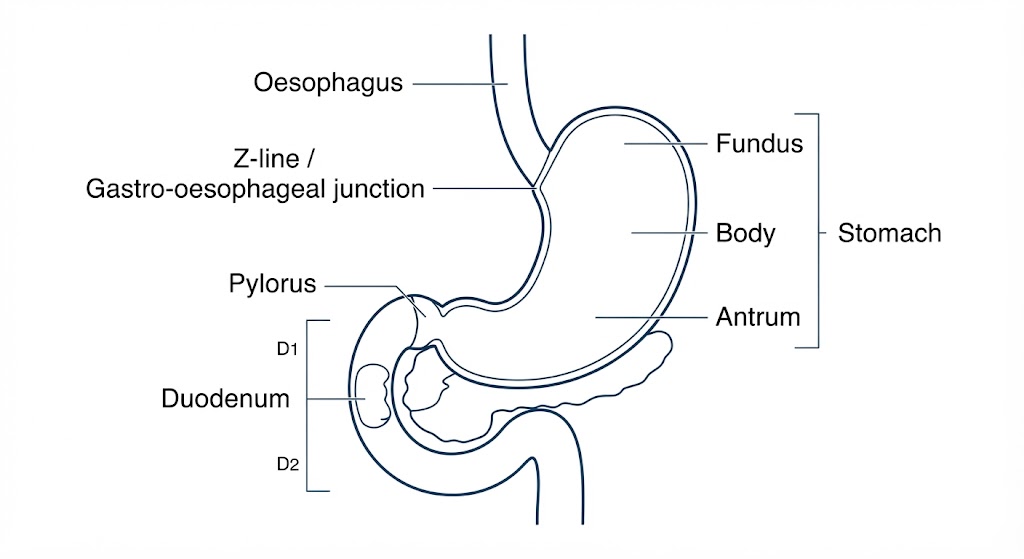
Words about the gullet (oesophagus)
Z line. The point where the lining of the gullet meets the lining of the stomach. It is often mentioned simply to show it was checked. “Irregular Z line” describes how it looked, and your team will explain whether it needs anything further.
Oesophagitis. Inflammation of the lining of the gullet, often linked to acid reflux. Reports sometimes give it a grade, commonly a letter from A to D (the Los Angeles grading), which describes how much of the lining is affected. Our acid reflux guide explains how reflux is treated.
Hiatus hernia. When part of your stomach moves up into your chest, through the gap in the muscle (diaphragm) where the gullet passes. It is very common in people over 50 and does not normally need treatment if it is not causing problems.[3] If it does cause symptoms such as heartburn, the usual treatment is medicine and changes to eating habits. Surgery is only usually considered if other treatments have not worked.[3] Reports sometimes give its size in centimetres.
Barrett’s oesophagus. A condition where the normal cells lining the gullet have been replaced with different cells.[5] It shows up as a red-coloured lining, and biopsies are taken to confirm it.[5] The length is usually recorded using the Prague classification, written as C and M numbers. C is the length, in centimetres, that goes all the way round the gullet. M is the maximum length, including any tongues of lining. So “C4 M5” means 4cm all the way round and 5cm at the longest point.[5]
People with Barrett’s oesophagus have a higher risk of a type of gullet cancer than the general population, but Guts UK notes that only about 1 in every 300 people with Barrett’s develop it each year.[5] That is why many people are offered repeat gastroscopies (surveillance) to keep an eye on it. How often depends on its length and what the biopsies show, for example every 2 to 3 years for longer segments and every 3 to 5 years for shorter ones.[5] Your team will tell you what applies to you. When patients reach the age of 75, the evidence for continuation of surveillance is weaker. The decision for ongoing surveillance tests is usually made on a center by center basis.
Dysplasia. A word you may see on a biopsy report rather than the gastroscopy report. It means the cells look abnormal under the microscope, and it is graded as low-grade or high-grade.[5] If dysplasia is found, you will be contacted about next steps, which may include an earlier repeat test or referral to a specialist centre.[5]
Words about the stomach
Gastritis and erythema. Gastritis means inflammation of the stomach lining. “Erythema” simply means redness. A report may describe the stomach as red or inflamed, and biopsies may be taken to look for a cause. Our gastritis guide explains more.
Erosions and ulcers. An erosion is a shallow break in the lining. An ulcer is a deeper sore. Ulcers in the stomach are called gastric ulcers, and those in the duodenum are called duodenal ulcers. Two common causes are infection with H. pylori bacteria and regular use of anti-inflammatory painkillers such as ibuprofen. Treatment usually lasts from 1 week to 2 months, and you may need tests afterwards to make sure it has worked.[4]
CLO test or rapid urease test. A quick test for H. pylori done on a tiny sample taken during the gastroscopy. Some units give the result on the day, while others test for H. pylori with biopsies or a separate breath or poo test. See our H. pylori test guide for the different tests.
Atrophic gastritis and intestinal metaplasia. These are changes to the stomach lining that are found on biopsies. In atrophic gastritis, some of the normal glands in the stomach lining have been lost. In intestinal metaplasia, some of the lining has changed to look more like the lining of the bowel. They are usually caused by long-term H. pylori infection, and less often by a condition where the immune system affects the stomach (autoimmune gastritis).[6]
These changes slightly raise the risk of stomach cancer over many years, which is why UK guidance recommends treating H. pylori if it is present.[6] The British Society of Gastroenterology recommends offering a repeat gastroscopy every 3 years if the changes are widespread in the stomach. If they are only in one part of the stomach (the antrum), it does not usually recommend repeat tests, unless there are other risk factors such as a strong family history of stomach cancer.[6] Your team will explain what applies to you.
Polyps. Small growths on the lining. Many found in the stomach are harmless, but they may be sampled or removed so they can be checked under a microscope.
Words about the duodenum
Duodenitis. Inflammation of the lining of the duodenum. It is described in the same way as gastritis.
Duodenal biopsies. Samples from the duodenum are often taken as part of routine checks, for example to look for coeliac disease. Seeing “D2 biopsies” on your report does not mean coeliac disease or anything else has been found. It means the samples were taken so it can be checked.
“Normal” and other short phrases
You may see phrases such as “normal”, “no abnormality detected” (sometimes “NAD”) or “normal to D2”. These mean nothing abnormal was seen with the camera. If biopsies were taken, the final answer may still depend on those results, so wait to hear back before drawing conclusions.
A normal gastroscopy does not mean your symptoms are not real, and this is something I often tell patients after their camera test. It helps your doctors rule things out and plan what to do next, which may be another investigation, or it may be a change or initiation of a medication.
What happens next
- Keep your copy of the report somewhere safe. It is useful if you see a different doctor later.
- Before you leave, ask who will send you the biopsy results and roughly when.
- If you have not heard about your biopsy results within the time you were given, contact the endoscopy unit or your GP surgery.
- Write down any words you do not understand and take them to your follow-up appointment or GP. You can use our free symptom diary to keep notes and questions in one place.
- Keep any repeat or surveillance appointments you are offered, even if you feel well.
When to get help
Some throat and tummy discomfort after a gastroscopy is normal and should pass within a few hours.[2] Follow the advice on the discharge sheet your hospital gives you.
Call 999 or go to A&E if you vomit blood, have black, tar-like poo, or have severe pain in your chest, tummy or throat after the test.
Get medical help straight away if you have a high temperature or feel hot, cold or shivery, or you keep being sick. The NHS lists these as signs to get urgent help after a gastroscopy.[1]
Ben’s view: read the report with the person who wrote it
I perform gastroscopies and transnasal endoscopies, and I have been JAG certified in diagnostic gastroscopy since 2018. Writing the report is part of every test. It is written quickly and precisely, mainly for your GP and the next clinician who sees you. That is why it can read like another language, and why a common, minor finding can sound far more worrying on paper than it is.
When I talk people through their findings in recovery, I try to cover three things: what I saw, whether samples were taken, and who will be in touch next. If you had sedation, you may not remember much of that conversation, and that is completely normal. Please ring the unit and ask again rather than searching for each word online late at night.
I also train doctors and endoscopy nurse practitioners, and one thing we always come back to is that the report is only one part of your care. The biopsies, your symptoms and your history all matter. That is why the person best placed to explain your report is the team who did it, or the doctor who asked for it. I would hate for my patients to go away worried and not have a point of contact, so I always tell patients to get back in touch with either myself, or a member of the department if there is a question they feel has gone unanswered.
 Ben Johnson
Lead Author & Advanced Clinical Practitioner, Gastroenterology
Frequently asked questions
How long do gastroscopy biopsy results take?
The NHS says biopsy results can take up to 2 months. If doctors think you may have cancer or they are a bit more worried about your endoscopy findings, you will usually get the results within 2 weeks.[1] Ask before you leave who will contact you with them.
Does having biopsies taken mean something is wrong?
No. Biopsies are taken routinely, both to check something that was seen and to rule things out. Taking them does not hurt.[2] Your team will tell you what the results show.
Why can’t I remember what the doctor or nurse told me?
If you had sedation, it is common to have little memory of the time straight after the test. This is why the NHS advises not driving, drinking alcohol or signing important documents for 24 hours afterwards.[2] Your written report and a call to the unit can fill the gaps.
Will I need another gastroscopy?
Most people do not. Some findings, such as Barrett’s oesophagus or widespread intestinal metaplasia, mean you may be offered repeat tests every few years to keep an eye on things.[5][6] Your team will tell you if this applies to you.
Who should I ask about my own report?
The endoscopy unit that did your test, the specialist who referred you, or your GP once they have the report. This page explains common words, but it cannot tell you what your own findings mean for you.
References
- NHS. Gastroscopy. Page last reviewed 13 August 2026. https://www.nhs.uk/tests-and-treatments/gastroscopy/
- NHS. What happens on the day: gastroscopy. Page last reviewed 7 April 2022. https://www.nhs.uk/tests-and-treatments/gastroscopy/what-happens/
- NHS. Hiatus hernia. Page last reviewed 8 May 2024. https://www.nhs.uk/conditions/hiatus-hernia/
- NHS. Stomach ulcer. Page last reviewed 12 August 2025. https://www.nhs.uk/conditions/stomach-ulcer/
- Guts UK. Barrett’s oesophagus: all you need to know about. January 2026. https://gutsuk-media-offload.s3.eu-west-2.amazonaws.com/2026/01/Guts-UK-Barretts-Oesophagus-Information-Leaflet-2026.pdf
- Banks M, Graham D, Jansen M, et al. British Society of Gastroenterology guidelines on the diagnosis and management of patients at risk of gastric adenocarcinoma. Gut. 2019. doi:10.1136/gutjnl-2018-318126. https://www.bsg.org.uk/clinical-resource/diagnosis-and-management-of-gastric-adenocarcinoma